
BlackREBranded
W.E.B. Dubois explains why he refused to vote
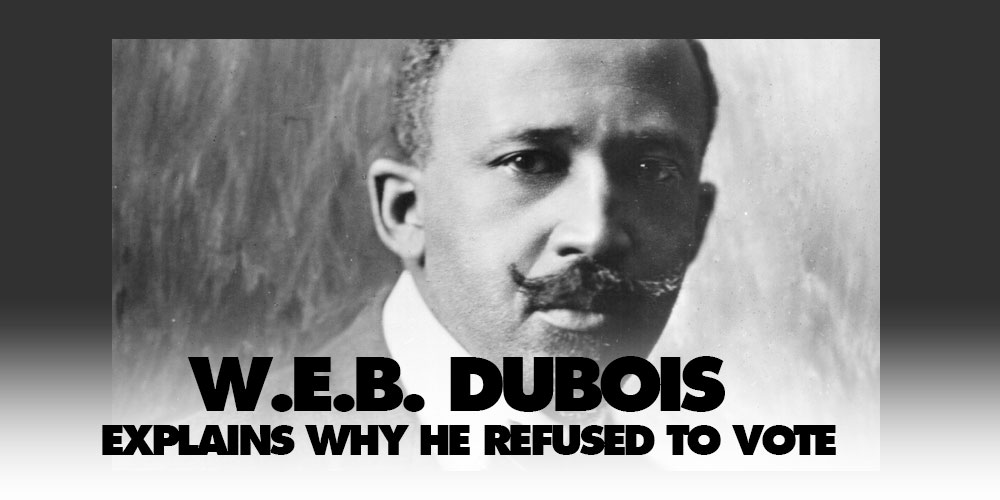
On October 20, 1956, W. E. B. Du Bois delivers this eloquent indictment of US politics while explaining to Nation readers why he won’t vote in the upcoming Presidential election. Du Bois condemns both Democrats and Republicans for their indifferent positions on the influence of corporate wealth, racial inequality, arms proliferation and unaffordable health care.
Since I was twenty-one in 1889, I have in theory followed the voting plan strongly advocated by Sidney Lens in The Nation of August 4, i.e., voting for a third party even when its chances were hopeless, if the main parties were unsatisfactory; or, in absence of a third choice, voting for the lesser of two evils. My action, however, had to be limited by the candidates’ attitude toward Negroes. Of my adult life, I have spent twenty-three years living and teaching in the South, where my voting choice was not asked. I was disfranchised by law or administration. In the North I lived in all thirty-two years, covering eight Presidential elections. In 1912 I wanted to support Theodore Roosevelt, but his Bull Moose convention dodged the Negro problem and I tried to help elect Wilson as a liberal Southerner. Under Wilson came the worst attempt at Jim Crow legislation and discrimination in civil service that we had experienced since the Civil War. In 1916 I took Hughes as the lesser of two evils. He promised Negroes nothing and kept his word. In 1920, I supported Harding because of his promise to liberate Haiti. In 1924, I voted for La Follette, although I knew he could not be elected. In 1928, Negroes faced absolute dilemma. Neither Hoover nor Smith wanted the Negro vote and both publicly insulted us. I voted for Norman Thomas and the Socialists, although the Socialists had attempted to Jim Crow Negro members in the South. In 1932 I voted for Franklin Roosevelt, since Hoover was unthinkable and Roosevelt’s attitude toward workers most realistic. I was again in the South from 1934 until 1944. Technically I could vote, but the election in which I could vote was a farce. The real election was the White Primary.
Retired “for age” in 1944, I returned to the North and found a party to my liking. In 1948, I voted the Progressive ticket for Henry Wallace and in 1952 for Vincent Hallinan.
In 1956, I shall not go to the polls. I have not registered. I believe that democracy has so far disappeared in the United States that no “two evils” exist. There is but one evil party with two names, and it will be elected despite all I can do or say. There is no third party. On the Presidential ballot in a few states (seventeen in 1952), a “Socialist” Party will appear. Few will hear its appeal because it will have almost no opportunity to take part in the campaign and explain its platform. If a voter organizes or advocates a real third-party movement, he may be accused of seeking to overthrow this government by “force and violence.” Anything he advocates by way of significant reform will be called “Communist” and will of necessity be Communist in the sense that it must advocate such things as government ownership of the means of production; government in business; the limitation of private profit; social medicine, government housing and federal aid to education; the total abolition of race bias; and the welfare state. These things are on every Communist program; these things are the aim of socialism. Any American who advocates them today, no matter how sincerely, stands in danger of losing his job, surrendering his social status and perhaps landing in jail. The witnesses against him may be liars or insane or criminals. These witnesses need give no proof for their charges and may not even be known or appear in person. They may be in the pay of the United States Government. A.D.A.’s and “Liberals” are not third parties; they seek to act as tails to kites. But since the kites are self-propelled and radar-controlled, tails are quite superfluous and rather silly.