
Entertainment
The Evolution of Lupe Fiasco
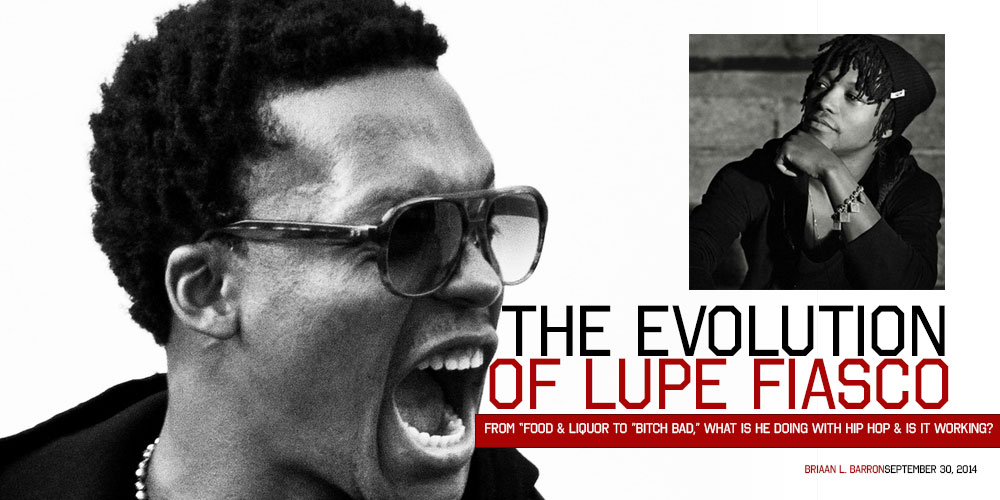
From “Food & Liquor” to “Bitch Bad,” What is he Doing with Hip Hop & Is It Working?

You ever heard someone describe their relationship with the statement, “When it’s good, it’s really good. But when it’s bad, it’s so bad”? That’s probably the best cliche to describe my relationship with Hip Hop. Having a fetish for conscious lyricism but an addiction to beats reserved for twerk anthems, I’ve struggled with a sort of cognitive dissonance familiar to a lot of critical Hip Hop fans. And as a Black woman, I grapple constantly with my loyalty to the genre–my inclination to defend it from misguided reprimands–and with my own disappointment in its propensity for sexism.
But in high school I met the music of Lupe Fiasco, and he provided the perfect buffer: just mainstream enough to have a good variety of head-bobbin’ joints and just conscious enough for me to feel like my brain cells were fully intact and active while listening to him. On top of that, he represented a nerd aesthetic that made my friends and me feel right at home as we blasted his music on the back of a chartered bus shuttling us between our prep school and the South end of town where we lived. I remember loaning one of my earbuds to a friend, urging her to hold it to her eardrum for the lyrics “Gangsta rap-based filmings became the building blocks for children with leaking ceilings catchin’ drippings with pots, coupled with compositions from Pac, Nas’s ‘It Was Written’ in the mix with my realities and feelings, living conditions, religion, ignorant wisdom and artistic vision, I began to jot, tap the world and listen. It dropped.” One of my favorite lyrics from “Hurt Me Soul,” these lines were among many from Fiasco’s debut album Food & Liquor that showed the rapper was much more than a brief contributor to Kanye West’s hit song of the time “Touch the Sky.”

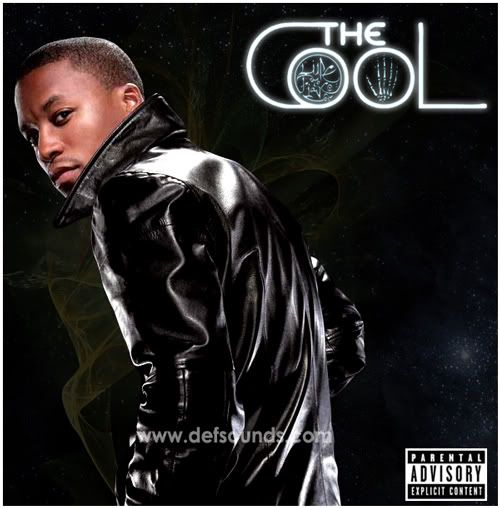
Food & Liquor’s darker sequel The Cool was born in the winter of ‘07: a concept-driven piece equipped with three primary characters whose personas Fiasco manifested in various tracks. This album took Lupe’s storytelling tone to the next level, using almost gothic imagery to tell a warning tale about street life and pursuits of wealth at the expense of one’s soul. Still, the rapper’s negotiation between challenging mainstream rap and staking some claim to it was evident. The album’s single “Superstar” utilized Matthew Santos’ slightly haunting alternative pop tone to make a track that’s catchy musically and a shallow critique of fame lyrically. While a passive majority would at least know Fiasco existed hearing and seeing “Superstar” in rotation, fans garnered from the Food & Liquor days would most likely be drawn to deeper cuts like “Little Weapon” or “Put You on Game.” I remember using the latter song in my final presentation for my sophomore English class to represent the destructive and cyclical nature of Capitalism.
Fast forward to 2012, I’m united with Fiasco’s music in a classroom once again. Except this time I’m in college, and this time instead of bobbing my head, I’m squinting my eyes and cupping my chin. I’m sitting with fourteen other students in a seminar called Racial Americana watching the music video of Lupe Fiasco’s latest release entitled “Bitch Bad.” The hook repeats, “Bitch bad. Woman good. Lady better. They misunderstood.” As I watch, I’m thinking , “I get what you’re trying to do here, Lupe. I get that you’re critiquing the current phenomenon of the self-proclaimed ‘bad bitch,’ putting it in conversation with minstrelsy in the U.S., and that’s why there’s a young woman on the screen in black face holding a syringe and posturing as if she’s about to inject something into her behind.” It’s a provocative image. And the juxtaposition of these visuals is causing some discomfort in the room, which I know is exactly what the artist intended. Lupe Fiasco has never been particularly subtle. Even in The Cool, the three main characters on which much of the album is based are named after the metaphors they represent: The Streets, The Game, and The Cool.

But something is different about this Lupe Fiasco than the one from years prior. It could be that my perspective has changed or that this is his first comeback since the release of his barely-memorable Lasers album. But I speculate that it has to do with the fact that he’s traded in his colorful streetwear for a suit and tie. His low-cut Ceasar has since sprouted locs, and he’s switched out his skateboard for a proverbial soap box. Looking around at the faces of the young women in the room, who happen to make up the majority of the population in this class, they aren’t taking too kindly to being lectured by Lupe on the issue of how they represent themselves and how that may impact upcoming generations.
And while I can relate to their apprehension, I can’t help but wonder why we’re mad at Lupe Fiasco for asserting this message. Spin.com definitely didn’t praise Fiasco’s effort, stating “Its hook goes, ‘Bitch bad, woman good, lady better,’ which sounds sweet and all, but does any female want to be called ‘a lady’?” Author Brandon Soderberg goes on to describe the song as “the umpteenth example of so-called ‘conscious’ hip-hop replacing one type of misogyny with another.” In what, I guess, is an attempt to defend a brand of feminism that’s gaining appeal in 21st century Pop culture, Spin.com queries if any “female” really wants to be called a “lady” anymore. Really? I’d rather be called a “lady” than a “female” any day, but I digress. The response to Lupe Fiasco’s “Bitch Bad” queued me to question where the space is in Hip Hop for a male voice to assert a position on the objectification of Black women’s bodies by both women themselves and by male gazers. Is it a damned if you do, damned if you don’t situation? And if Macklemore could use his platform to be a voice for same sex marriage, who’s the next leading male voice in Hip Hop (or voice in general, for that matter) to make a statement against misogyny?
More recently, it seems that Fiasco has tried a different approach. His collaboration with Ty Dolla Sign, well known for his contribution to popular vernacular with the song “Or Nah,” could either read as a sellout move or a test to see if we’re still listening. Looking back at Fiasco’s previous choices, I’m banking on the latter. But the agenda that the rapper continues to push of putting up a mirror to problematic self-representation among Black men and women has a tough battle ahead. Especially as terms like feminism become attached to the type of imagery and behavior that the rapper critiques, which sometimes complicates the conversation about the history of hypersexualizing Black women and how it manifests in media today. Whether or not Lupe Fiasco’s methods are working to fulfill his goal or are flying over listeners’ heads completely, he’s been consistent in his mission to offer an alternative perspective in mainstream Hip Hop. And for the time being, I’m still listening.
Briaan L. Barron