
BlackREBranded
Black Renaissance Bandits – Pt.1: On the Phrase ‘Black Culture’ December 28, 2014
Briaan L. Barron
“You Owe Me the Right to my Identity” – Azealia Banks
“Don’t y’all know the drill?” Hot 97 DJ Ebro Darden posits rhetorically to Azealia Banks. The 23-year-old rapper emits an energy starkly different from her first brash, upbeat hit “212.” An emotional Banks addresses her grievances with artists like Iggy Azalea, who reap mainstream rewards for perpetrating as the voices of current Hip Hop. This interview comes at a moment when the topic of white artists benefiting from the appropriation of Black musical genres continues to gain momentum in mass media amidst dialogues around systemic injustices toward Black lives. But like Ebro submits, these interventions aren’t new.
So why must we sound like a broken record? Because while the concept of white public figures co-opting forms of expression that originate from a distinctly Black experience is not a new tune, we must continue to explore and interrogate this pattern in the context of right now. A time when terms like “globalization” and “melting pot” are used to frame the erasure of cultural, regional, and historical origins as modern and progressive. As we [should] know, the erasure of origin stories blurs our lens on historical patterns, blinding our discernment of current realities and probable futures (detailed later in BRB Pt.2 “On The Melting Pot Argument”).
But as I have been witnessing commentary on appropriation in rap lately, much of it makes warranted but hasty, convoluted attempts to draw ties between Hip Hop, Bill Cosby, and Ferguson. Such is the struggle of trying to position facts and rage in the same space without de-legitimating either, while navigating a world of Internet trolls, character limits and competing headlines. I see a glaring need for more pointed and disciplined reflection. So in part 1 of my series Black Renaissance Bandits (BRB), I’m focusing on examining our use of the phrase “Black Culture.” I attempt to synthesize why Black Arts matter to Black identity, drawing from Amiri Baraka’s account of the 1960’s Black Arts Movement. I also want to distinguish Black Culture from Black Caricature so that we don’t develop an accidental habit of conflating the two (which, I think, is already happening). And finally, I want to expose the limits of searching for cultural authenticity and integrity in a sensationalistic industry.
When Azealia Banks tearfully proclaims “You owe me the right to my fuckin’ identity” in her Hot 97 interview, it is not the cry of a fellow female emcee trying to disguise brittleness as commentary, like many have been quick to insist. Or if it is, that’s not all it is. Her argument is consequence of a point that recently-deceased poet, writer, and activist Amiri Baraka makes in an essay entitled “The Black Arts Movement”: “…no matter how much we might be ‘recognized’ or ‘accepted’ or even ‘lionized’ as artists, we were still somehow burdened with the disorienting realization of alienation.” The arts has been a space in the dominant narrative where ‘Blackness’ has held a positive connotation under the condition that it is compartmentalized as entertainment. That’s to say, divorced from political merit or agenda.
The Black Arts Movement of the 1960s, an influential predecessor to Hip Hop, deliberately rejected such a separation. A coalition of artists and intellectuals, the Black Arts Movement took root in Harlem, NY, distinguishing itself geographically and ideologically from the “standard bourgeois aesthetic of separation of arts and politics” that characterized the climate of Greenwich Village.
Today still, the commonplace “It’s just entertainment” argument connotes that art with a political agenda is, at the least, limited and, at the most, not authentically art. However, Baraka describes the necessity of a political art as a means of breaking the limitations of abstraction.
“In a deep sense the music, jazz, blues, new music, these were sustaining elements of our lives. We could feel ourselves, we could become truly self-conscious inside it. And as the 60’s moved on, a significant sector of Black artists downtown became more and more isolated from that so called ‘mainstream’ by the growing need to fully express our soul and mind connection with Black struggle in our art and in the street.”
The intentionality of the Black Arts Movement, its aim to create physical and ideological space to articulate a Black experience through various artistic languages, disrupted more than just the popular function and reading of art. It disrupted popular notions of how Black people should seek liberation. It disrupted the accepted narrative of Blackness. And the name chosen for the movement was as significant in this mission as the content and ideas it produced.
“We linked the common Eurocentric distortion of Black Arts as an evil magic, as a mystic pursuit. A power used to transform reality. We had long before understood the twisted racism of Europe and America when referring to Black. That everything Black was bad. But we was Bad, in fact we was trying to get Badder dan Nat. We was trying to get outright ‘terrible.’ Understanding, in various degrees, that ‘to turn their Evil backward, is to Live!’.”
Consumers and creatives now have been conditioned to see the integration of Hip Hop into the fabric of American culture as emblematic of success and advancement. But when one considers the assertion that departure from the ‘mainstream’ was essential to the integrity of Black art forms, it complicates the idea of integration as advancement that has become all too easy to accept in contemporary society. Even Questlove of The Roots posits, “So what if hip-hop, which was once a form of upstart black-folk music, came to dominate the modern world? Isn’t that a good thing?…Maybe. Or maybe it’s a little more complicated than that. Maybe domination isn’t quite a victory. Maybe everpresence isn’t quite a virtue.” (Questlove)
So, we focus back on the current moment. The world is witnessing Iggy Azalea in a seemingly impressive, or at least alluring feat of mockery, swapping in and out of her rap persona as if an exaggerated Black vernacular were as disposable as chewing gum. And as quickly as she can flip her bone straight blonde locks over her shoulder and strike a derriere framing pose, she’s swept into the discourse about cultural appropriation. But I have to say, I think we’re grossly misusing that phrase. “The arts and other manifestations of human intellectual achievement regarded collectively.” That’s the first definition of “culture” that a Google search result renders. By no means am I suggesting that Google or even Merriam-Webster is the standard by which we should understand all language and concepts. But I think it starts to reveal the importance of the very exercise of defining the terms we use.
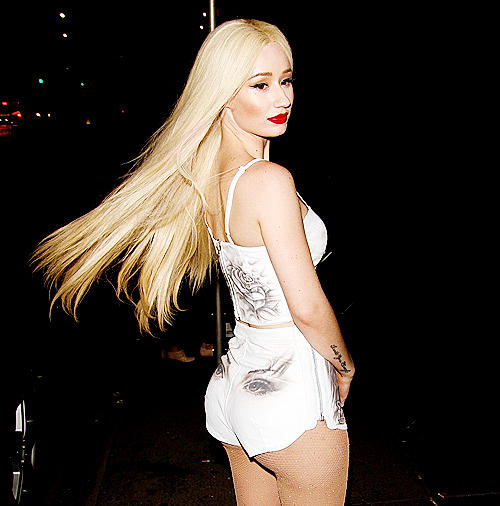
Throwing on the trappings of a cartoon version of Blackness and accepting accolades and rewards for it is not cultural appropriation. It’s minstrelsy. And the danger of defining it as cultural appropriation is the inherent assumption that what we’re seeking to defend, what Azealia Banks is eager to retrieve back when she says “You owe me the right to my fuckin’ identity,” is this warped caricatured knock-off of Black representation. From my vantage point, there exists a sort of resentment if not regret about the way rap manifests now. So mainstream, so global, so easy to embody and imitate, that it no longer requires the host of a Black body to obtain legitimacy. The one space in the national imagination in which Blackness was embraced as positive and even novel is no longer Black. Now we’re forced to grapple with the implications of a colorless Hip Hop.
In some senses, Hip Hop’s conversion to mainstream has meant that artists, who see the potential to influence the masses by telling their stories and/or recognize fame as a refuge from social margins, accept the caricature of Black representation in order to gain access to the world stage. This choice has created opportunity for subversive social, cultural, and political work. But now we see the compromise seeping through the glory. By animating the Black Caricature and permitting it to co-exist alongside Black Art in the category of culture, have we contorted our own concept of identity? Are we really at a point where a white girl shaking her ass or flashing a grill is a threat to the legacy of Black culture?
In 1970, James Baldwin wrote to Angela Davis, “The American triumph—in which the American tragedy has always been implicit—was to make black people despise themselves.” Perhaps now, and in decades to come, the American triumph is to make Black people forget themselves. Forget that our value and influence is not predicated upon mainstream taste-making institutions like the Grammys. Forget that we once perceived departure from those institutions as essential to our artistic integrity. Forget that our CULTURE is not a cartoon, a costume, or disposable. Iggy Azalea doesn’t “owe us the right to our identity.” Why should we expect her to engage with Black politics or struggle any more than we would have expected a blackface minstrel performer in the 19th and 20th centuries to? We do owe it to ourselves to continue demonstrating, through an ever-evolving consciousness and creativity and through strategic use of our intellectual and monetary capital, that Black culture is neither replaceable nor eraseable.