
Uncategorized
The Ferguson Masterpost: How To Argue Eloquently & Back Yourself Up With Facts a white persons guide to activism .
Introduction From The Curator
Note (11/29/14 at 8:00 PM EST): Holy moly, this got a ton of traction. Thanks to all the folks sharing, commenting, and helping us correct typos, inaccuracies, and the like! Keep it coming, but please note that comments are moderated to filter out spam & this is a one-woman-show from a busy lady, so responses and updates will not be immediate. We’d love to hear what you’re doing with this information, so definitely let us know of success stories in talking to family-members, using it in lesson-plans, and the like.
The only kind of bombs I fully support are truth-bombs, and that’s why I’ve come together with a group of POC and select White allies to write this post. We feel it’s critical to have conversations about social justice loudly, noticeably, personally as well as systemically, and eloquently*—in this case, specifically around Ferguson, #stoptheparade, #BlackLivesMatter, #IndictAmerica, and all the myriad things happening right now around police brutality and the devaluing of Black lives. We need to connect our struggles and see where they intersect, while not pretending that we all face the same issues (today I’m lookin’ at you, non-Black POC). To do this, we need tools, scripts, data—means of having and supporting these conversations, as well as our communities.
That’s why we’re here.
We want to give you tools to support that work and that dialogue. If you’re facing tough questions from friends, family, colleagues, or even perfect strangers, we hope this will help you answer them. We need to collectively build support and awareness to build a better society, and part of that means challenging those who assume “we are already there,” exposing those who would further marginalize already disenfranchised communities, and educating those who do not see why any of these things are issues in the first place. Please contact me if you find any inaccuracies in this post; we’ve worked hard to dig things up, but sometimes new details come to light! You may also want to peruse other “master posts” that are out there (1, 2, 3, 4, 5, 6, 7, 8). If you just want to read “what next, and how can I help?” you should scroll all the way to the bottom.
Note 11/29/14: Also consider this a living document! If you have things to add, put them in the comments! Because this is a collective work, there may be areas that need to be clarified, cleaned up, or entirely fixed. Further note: this article is not “Is Darren Wilson Guilty? Was Mike Brown innocent? We have the answer!” — this is a tool for discussions, compiling useful information to PRIMARILY speak about police brutality, racism, and the like.
With Love and Solidarity,
Aida
The fantastic team who helped out and suggested info included: Renee Cotton (who was a total rockstar), Luisa Ramírez-Lartigue, Sara David, Linda Hower Bates, Tamara Williams, Michael Becker, Katie Lamb, Dani Da Silva, Shanice Yarde, and G Starr Vidal.
Note (11/29/14 at 9:25 AM EST): To clarify, just because we link to something doesn’t mean it’s an endorsement or that the source is completely unproblematic. For example, while I personally have my issues with Tim Wise and how many institutions choose to bring him in to speak vs. the many POC who have been doing anti-racism for longer, we do include information about his documentary here.
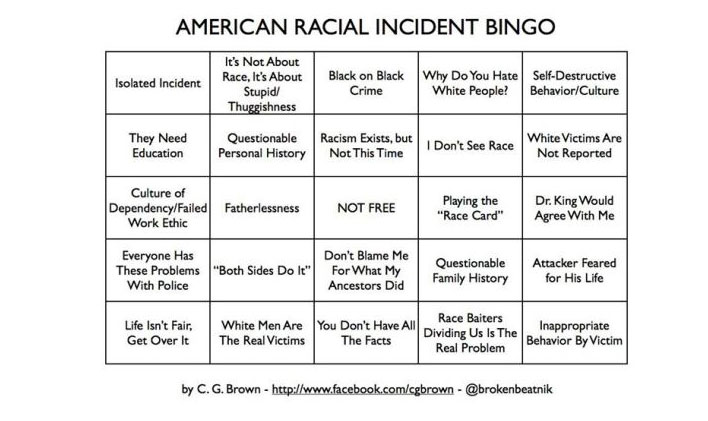
P.S. We encourage you to play “racial incident bingo” as you go about your day discussing these issues. We can’t promise the results won’t be totally depressing.
 *Note (11/28/14 at 9:25 PM EST): Eloquence should not be a pre-requisite for being listened to, particularly when talking about members of a group who are marginalized and speaking about their experiences. While we (the folks who made this post) do overall value eloquence for many reasons and feel it is an important tool in the overall kit, it is important to clarify that point, because to require eloquence from people speaking about their pain and oppression, especially when wounds are still fresh, is pure respectability politics BS, and we don’t support that.
To Refute Fake Facts, Misleading Information, & Inaccuracies
But Mike Brown robbed a convenience store!
“Attorney for the Ferguson store, Jake Kanzler, said the Ferguson store owner, [sic] nor any store employee called the police to report any shoplifting of cigars, but, rather, a customer called the police.” (here.) [Update 11/29/14: Since people are commenting on this, we want to note that we decided to include it because some folks were stating that Mike Brown robbed a convenience store and that the store owner is the one that reported it to police. We do not mean to imply that only the store owner could have or should have reported a robbery.
Absolutely NO stolen things presented as evidence in the grand jury testimony (link to evidence above). [Update 11/29/14: Again, as above, just information to reply to those saying that it got used.]
The core issue remains: since when is theft/robbery punishable by death? Most people are using the “robbed a convenience store” argument to imply that Brown was thus “a criminal” (and all that entails). How many people have stolen things from convenience stores? How many young White girls have stolen lipgloss from a pharmacy? Come on. [Update 11/29/14: We aren’t arguing so much about the “did he steal or not” but about the framing and the use of this to characterize Brown as “a thug who deserved what he got.”]
[Added 11/29/14] Since so many folks are bringing this up, here’s the video and the stills from the convenience store theft. Once again, we are not arguing about the theft. This video wasn’t included previously in this post because the point we are making is about the framing of the situation, not “did he steal or not?” Something else noteworthy is that it’s been reported that the Ferguson Police Chief Thomas Jackson said the reason for contact between Wilson and Brown was not due to the robbery. Apparently the story changed later, though, which is curious.
Mike Brown was a giant demon who charged at Darren Wilson, who had no chance but to fear for his life and use lethal force.
Darren Wilson is 6’4”, 215 lbs. He had a gun and a car. Mike Brown was an unarmed 18 year old, also 6’4”, and 289 lbs.
Please also take a peek at our section below covering the question “What if Mike Brown had been White? Would you still be outraged? Would it still be police brutality?”
Photographs of Wilson’s injuries don’t show much. Hospital discharge report writes that he had a facial contusion—a fancy way of saying bruise—check page 4. The prescription in the discharge is for ALEVE (Naproxen), an over-the-counter drug.
[Section updated 11/29/14] Whereas there’s documentation about Wilson, the photographs of Mike Brown’s body by the medical legal investigator were not taken because the THEY RAN OUT OF BATTERIES (from grand jury transcript, page 31-32) which is completely ridiculous and unacceptable. As a commenter notes: “To be clear, that’s not the person who conducts the autopsy; it’s the person who initially goes to the scene and orders that the body be delivered to the medical examiner.” Apparently the police took pictures, but they don’t get discussed much here. Though measurements are usually also taken, the medical investigator did not “because it was self explanatory what happened. Somebody shot somebody.” [We include this, not to say that measurements were never taken at all, because they were (and you can peek at the state examiner’s autopsy report here), but to show some of the problems with how this case was handled from the beginning.]
Mike Brown smoked pot regularly and/or was high during his interaction with Wilson.
Know who else has smoked pot? Justin Bieber. And these grandmas. You should also be aware that marijuana has been decriminalized in 18 states, deemed legal for recreational use in 3 states and D.C., and medical marijuana is legal in 23 states and D.C.
Again, this does not justify shooting Brown.
The toxicology report was positive for cannabinoids in Mike’s system, but it’s important to note the following: “The toxicologist testified that Brown’s blood contained 12 nanograms of active THC per milliliter, a level that he said indicated Brown had consumed cannabis in the previous two or three hours. That contradicted testimony by Dorian Johnson, the friend who was with Brown when Wilson shot him. Johnson, who said he was with Brown all day, testified that they had planned to get high […] but never got around to it. Despite the blood test results, Johnson could be telling the truth. Daily marijuana users have been known to register 12 nanograms or more when they get up in the morning, and they may even perform competently on driving tests at that level.”
Furthermore, as the above link points out, during the testimony there was a conflation of dosage and blood concentration, which was super misleading to anyone who heard it and took it at face value.
“Pot is most popularly known as a sedative that relaxes users. One of the prominent arguments against its use, in fact, is that it makes users so sedated that they’re lazy and, as a result, unproductive.” and “There’s actually no reason to believe, based on the available research and the scientific understanding of pot, that marijuana would actually make someone more violent,” Lopez writes.”- German Lopez, Vox
Mike Brown was reaching for a gun when killed.
[Updated 11/29/14] He was unarmed and 12 distinct witnesses (of the 14 that spoke to the issue) testified that he had his hands up—the universal sign of “unarmed, don’t shoot” when he was killed (though there was a lot of contradicting eyewitness info, that was one of the things with near unanimous agreement). Regardless, the fatal shots that killed Brown weren’t shot while he was near the police vehicle, when Wilson claims he was reaching for the gun.
Mike Brown was a threat and could not be taken into custody alive.
Interesting argument, since many, many known-to-be-dangerous individuals are taken into custody alive all the time. Random example: cop killer, Eric Frein, captured alive (White) while a slew of Black men aren’t as lucky.
During Darren Wilson’s grand jury testimony, he repeatedly said he did not carry a taser because it is “not the most comfortable.” Because it is more comfortable to use lethal force, apparently.
To Address Ignorant &/Or Misguided Questions and Statements
Q: Why are you making this about race?
Before anything else, look at the responses to events in Ferguson—from those thanking Officer Wilson with racial epithets, to those understanding that this is about institutional racism. Regardless, the responses are proof that it is unequivocably about race:
Note all these racist public posts on social media. More racists here. [TW for the obvious horrors.]
Then, there’s the list of unarmed Black folks murdered by police.
If you want to listen to a spoken word poem that will break your heart andaddresses this, peep the video by Javon Johnson.
To quote Lisa Wade: “A Pew study found that 63% of white and 20% of black people think that Michael Brown’s death at the hands of Darren Wilson is not about race. Those people are wrong.” See why here.
Some food for thought: young Black men are 21 times more likely to be shot dead by police than White men. “Police kill Black Americans at nearly the same rate as Jim Crow era lynchings.” [Added 11/29/14: A commenter clarifies that the folks who made the graphic probably meant in the same quantities, not the same rates.]
Just know that 2,200 National Guard troops were deployed to Ferguson (compared to 3,100 in Iraq).
[Added 11/29/14] Someone emailed me share information about #BlackPoetsSpeakOut: “in solidarity with the movements to address racial injustices related to police brutality, including the killing of Michael Brown, poets have been reading poems online under the hashtag #BlackPoetsSpeakOut.” You can read some of them here.
Q: What did riots ever solve? Why are people getting violent?
Open a history book and take a look at the social change accompanying riots—from basic rights for Blacks and women, to voting rights, to ending war. Succinct case in point here and there.
“My name’s DeAndre Smith and this is exactly what’s supposed to happen when injustice is happening in your community.”
“‘So are you saying we should just give up?’ That’s what people ask me when I say things like this. My response: ‘eh, how about just not reducing everything to patience and progress?’ Don’t ask kids to wait around and dodge bullets until the system treats us fairly. Just stop putting that on them. Believe it or not, you don’t have to save the world. And you sure as hell ain’t going to do it on Twitter. Just step back with the riot shaming, and work on your perspective.” – Tyler Reinhard, Hey, Step Back with the Riot Shaming
People are totally chill with Black Friday sales and going NUTS over them to the point of injuring others, but social justice protests are “too much.”
“The protesters in Ferguson aren’t irrational or apolitical. They are calling attention to their basic, unmet needs.”
Peter Linebaugh: “…the thirsty do not ask permission to take a drink, nor the hungry food. Is it the new society? Of course not. But it could be; this is self-activity.”
Finally, if you’ve ever attended a Pride parade and ESPECIALLY if you’re LGBTQIA, did you forget the Stonewall Riots?
[Added 9/29/14] Some people take the “chaos” as a good time to hurt folks in the movement, as with the death (being investigated as a homicide) of Deandre Joshua (TW because the beginning of the article details his death), a friend of Dorian Johnson—who was with Mike Brown when he was killed.
[Added 9/29/14] One of the folks who commented on this post shared this and this, essays that give more historical information about riots, looting, and the rationale behind these behaviors.
If there are more black people in jails or getting arrested, it’s probably because they commit more crimes.
There are a few things at play here. First, let’s take a look at how the definitions of criminal activity are decided in the U.S. — “Social Construction of Crime” from 21st Century Criminology, Sage. 2009.:
“From the social constructionist perspective, crime is a classification of behavior defined by individuals with the power and authority to make laws that identify some behavior as offensive and render its perpetrators subject to punishment….What behavior they define as crime reflects both their own values and interests and the collective norms and values of the society, or at least the most vociferous segments of it.”
So, the group in power makes rules and chooses to prosecute petty crimes disproportionately by Blacks and simultaneously let white-collar (mostly by Whites) crimes off with a low punishment, though the total economic cost there is much higher than the petty crimes. Makes loads of sense, right?
If you want to get more theoretical, read about the commodification of security, changes in the nature of surveillance, and more.
Who actually commits the most crimes? Take a look at the proportions versus actual numbers of crimes by race. For a more thorough look at the data and how it is manipulated especially in the media, read here. And to put the nail on the metaphoric coffin here, even though Black men are more highly policed, they are not more likely to precipitate police violence. In fact, “police are more likely to kill black people regardless of what they are doing” and “the less clear it is that force was necessary, the more likely the victim is to be black.”
Blacks and some other groups under the POC umbrella are disproportionately charged with misdemeanors and face frequent police interruption or harassment (perpetual court fees and arrest when unable to pay) in their daily lives, say, for jaywalking. Or maybe your license plate holder is particularly sweet—lawsuit here.
The thing about the Ferguson disparities in arrests is that it’s not actually that unique at all.
Want more proof? Check out “The House I Live In” documentary which tackles the War on Drugs and details changes in drug laws and how these disproportionately and INTENTIONALLY criminalized communities of color. Even just the differences in sentencing for use/possession of different types of cocaine (broken down along racialized lines) speaks volumes. None of these things happen accidentally.
Finally, looking into the “school-to-prison pipeline” (“a disturbing national trend wherein children are funneled out of public schools and into the juvenile and criminal justice systems”) is critical in understanding why there are so many people of color in prisons. This heavily affects Black children, children with disabilities, and those at the intersection of both identities. Here’s a great fact-sheet and infographic on it.
Q: What if Mike Brown had been White? Would you still be outraged? Would it still be police brutality?
It would’ve still been police brutality, which is deplorable, but not part of a pattern of systematic brutality against a particular group of people. Watch Melissa Harris-Perry break it down in this video.
Another issue at hand here is that the media describes White versus Black crime differently. For a quick, timely example, look at how Mike Brown is immediately vilified and described as “no angel” while Ted Bundy, a horrific mass murderer, is given way more than the benefit of the doubt. This isn’t just the media, though. The American Psychological Association reported that Black boys are seen as older and as less innocent than White boys.
This media bias is being directly and visually confronted by people using the #IfIWereGunnedDown and #IfTheyGunnedMeDown hashtags. You can see the collection of pictures here.
Language matters because it frames and informs our perspectives. The metaphors we use both reflect and create our realities. The fact that Darren Wilson described Mike Brown as looking like a “demon” and that he felt like “a five year-old holding onto Hulk Hogan” is not just innocent description; it’s telling us A) how Darren Wilson understood the existence of Mike Brown and B) how he, as a Black youth, was dehumanized and distorted in Wilson’s eyes.
“These people are destroying their own cities!”
Here are just a couple of instances where White people have rioted and destroyed property over petty things, but you do NOT see the same level of media condemnation or widespread White hate about it. [Added 11/29/14: Wikipedia also has some articles on it.] The disproportionate attention (from individuals as well as the media), racialized framing, sensationalizing, and condemning of the actions to engage with the issues in Ferguson = deplorable.
Protesters are protecting stores from looting and destruction. Some report that gang-members (Bloods and Crips, specifically) are seemingly working together to help (seen here and in HuffPo video above), but we can’t say for sure here!
Here are some examples of White people rioting.
Social change is difficult. While the events in Ferguson appear chaotic, it’s important to appreciate the beauty in small kindnesses and people helping each other. There are fundraisers in Ferguson for feeding students, rebuilding a looted bakery, and repairing the Ferguson Market Store.
The Ferguson library is also doing great community-building work.
Q: Why do Black people take this so personally?
As one person so succinctly put it: “Because, for us, we are one bullet away from our brothers and fathers becoming hashtags.”
A friend said at a vigil: “with a White cop becoming a millionaire after shooting one of us, it is basically open season on our asses.”
Black people are taking it personally because it IS personal. These injustices and this violence perpetrated against Black people affects them both directly and indirectly, no matter where in the U.S. they live. Not indicting Darren Wilson has reinforced the message (that is not new, by the way) that Black lives are not as worthy of discussing, saving, or supporting. That is a message being sent to all of America, and directly affecting Black people.
This image summarizes some of the reasons why black folks have every right to be pissed off.
“These killings come on top of other forms of oppression black people face. Mass incarceration of nonwhites is one of them. While African-Americans constitute 13.1% of the nation’s population, they make up nearly 40% of the prison population. Even though African-Americans use or sell drugs aboutthe same rate as whites, they are 2.8 to 5.5 times more likely to be arrested for drugs than whites. Black offenders also receive longer sentences compared to whites. Most offenders are in prison for nonviolent drug offenses.” – Adam Hudson
Finally, you can read the article from Salon by Brittney Cooper: In defense of black rage. If you’re feeling artsy, listen to the song “Black Rage” by Lauryn Hill.
Q. This is not the dream that MLK fought for. What would he say about all this?
If you’re feeling cheeky or snarky, you can just respond with I “literally don’t know because he was shot and killed too.”
If you’re NOT feeling snarky, we have a response ready too, since MLK actually did comment on riots when he was alive, and said they were “the language of the unheard” and that condemning riots without condemning the conditions that lead people to them would be reprehensible. In fact, he would call that “morally irresponsible.” Here’s his full quote: “I would be the first to say that I am still committed to militant, powerful, massive, nonviolence as the most potent weapon in grappling with the problem from a direct action point of view… But it is not enough for me to stand before you tonight and condemn riots. It would be morally irresponsible for me to do that without, at the same time, condemning the contingent, intolerable conditions that exist in our society. These conditions are the things that cause individuals to feel that they have no other alternative than to engage in violent rebellions to get attention. And I must say tonight that a riot is the language of the unheard.”
As Jay Smooth put it: “The fundamental danger of a non-indictment is not more riots, it is more Darren Wilsons.” Check out how Jay Smooth breaks that down in this video where he addresses MLK, human limits, and riots.
Here is MLK talking about order and “White moderates,” the people who prioritize order over justice, who are in his opinion the most dangerous and the most detrimental to Black folks’ fight for justice and freedom.
“If you’re out causing trouble, of course shit’s gonna happen!”
First of all, what does “causing trouble” mean? Reducing direct action and protests to achieve goals of visibility to “trouble” minimizes their goals, impact, and meaning. It’s a clear tactic to make something seem worthless, like “drama.” If we ignored all that, though, the problem is that shit doesn’t happen equally when you account for all other factors. Black men are seen as “causing trouble” even when doing the exact same thing a White man would do and who would not be read as “causing trouble.”
Saying these protests are “causing trouble” is in the same line of victim-blaming thought that excuses rapes, and often perpetuated by the same people who look at White murderers and call for compassion, or focus on the fact that they “must have been disturbed or mentally ill to do these horrible things.” See that summed up in a single tweet here.
In response to arguments like this, where Black men are told to “pull up their pants” and “get educated” as a means of protection from state violence, a set of tweets notes how the argument is terrible and relies on broken ideas and respectability politics. Many Black and Latino parents do give this kind of advice to their children anyway in hopes of shielding them from harm, but it’s very different coming from White and non-Black people.
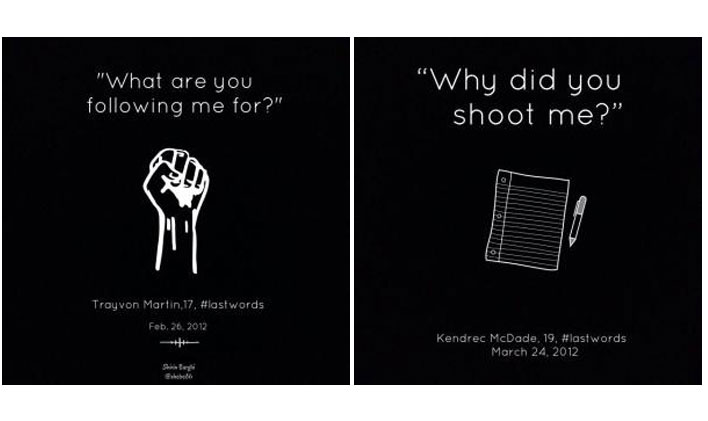
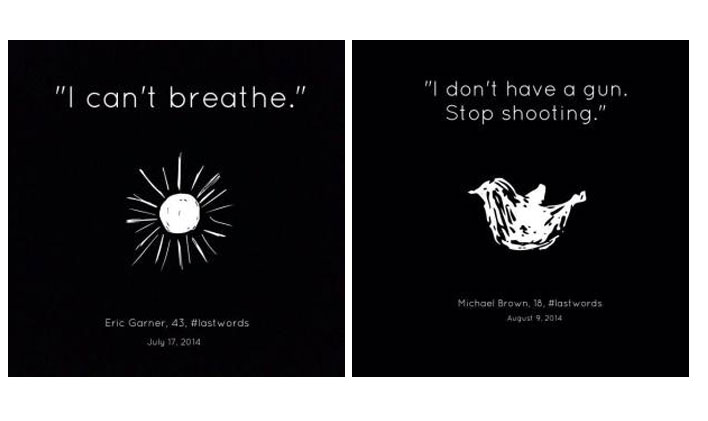
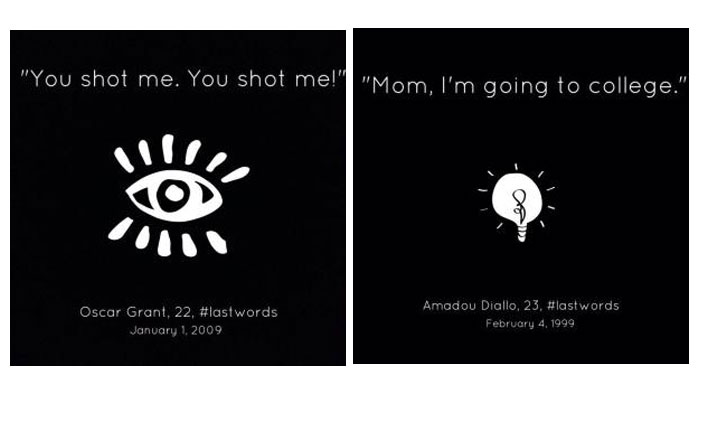
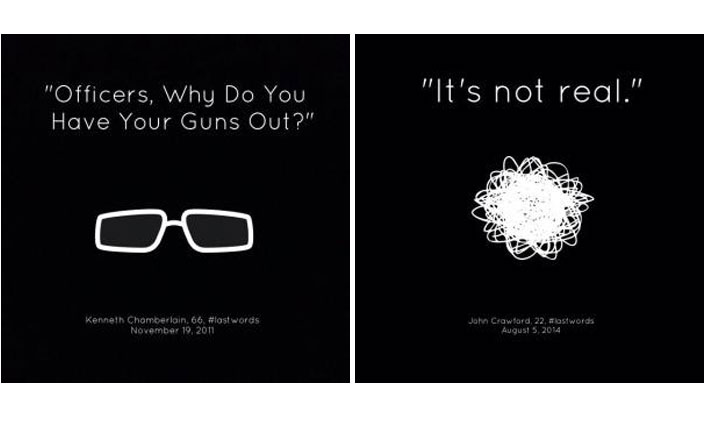
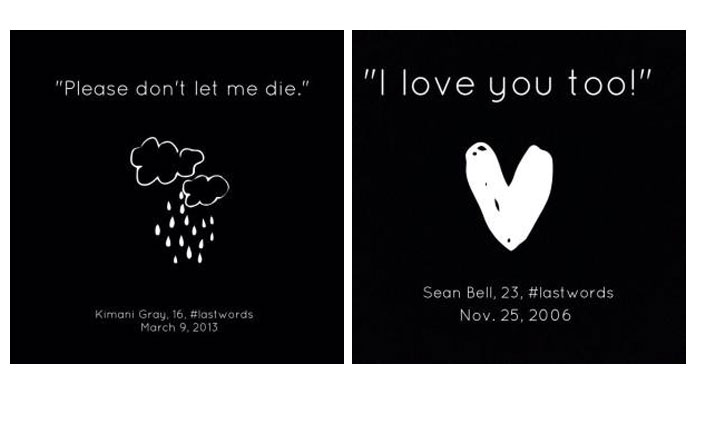
Iranian-American Shirin Barghi made some heartbreaking art of the last words Black folks like Mike Brown and Trayvon Martin uttered. There’s also art for Kimani Gray (16), Kenneth Chamberlain (66), Eric Garner (43), Amadou Diallo (23), John Crawford (22), Oscar Grant (22), Sean Bell (23), and Kendrec McDade (19).
“People should just stay home if they want to be safe.”
That’s like saying you shouldn’t eat because you’ll risk food poisoning or that women should be able to protect themselves against rape. [Note 11/29/14: This framing is purposeful to mirror common arguments, but we do not mean to imply that people outside of the “woman” category do not experience rape or that women can’t be rapists.] Ultimately, we shouldn’t live in a country where people are afraid for their lives if they leave their homes.
Even without leaving their homes, POC, and especially black folks, aren’t necessarily safe, especially from police brutality. Take a look at Harvard Professor Henry Louis Gates, Jr. Or these children [some folks report this link isn’t viewable on mobile!]. Or Cambodian families in Providence, RI. The list goes on.
Q: Are you blaming Darren Wilson for defending himself?
We’re actually blaming a cop for using lethal force when it was not necessary (the National Bar Association—the nation’s oldest and largest national network of predominantly African-American attorneys and judges—is decrying this “no probable cause” nonsense). What we’re also doing is pointing out a pattern of police brutality aimed at Black communities. Random sampling: twenty different stories and Armand Bennett.
Here are some tweets by Jesse Williams on just that.
Q: Why is it okay for Black people to address all White people as a whole, but White people can’t do the same thing back? What about reverse racism?
A short explanation about why reverse racism DOES NOT EXIST. However, if you still think reverse racism is a thing, here’s a good video to watch. Or perhaps read this handy step-by-step list about what reverse racism against Whites would look like!
But to answer the core question: because there’s this thing called metonymy, and there’s this thing about jokes/snarky statements being okay if the punchline is an oppressor/oppressive identity but not if the butt of the joke is a marginalized group or person. This human perfectly explains it. And why would metonymy be inappropriate from White people directed at Black people? Well, it’s not ALWAYS inappropriate (like “Dear Black People, We are sorry for being terrible to you, Love White People”), but this argument usually comes from someone trying to say something racist about Black people, in which case, yeah, no. Please stop.
Here’s another way of looking at it: “When choosing the butt of a roast joke or story, pick big targets. Never make fun of a small target (janitor, secretary, etc.). Make fun of the boss. He or she is still the boss after all the teasing and will look like a great sport for going along with it. Members of ‘in’ groups can joke about their peers and insult each other all they want. Bob Hope made fun of Ronald Reagan. Everyone knew they were buddies.“
Some other thoughts:
“Black people have to learn everything about White people just to stay alive. White people just don’t get that.” – Most White People in America Are Completely Oblivious
I am not delusional, so please don’t be incredulous. “When white friends don’t believe what blacks go through, they’re not friends”
Why White allies should think before immediately un-friending their racist family and friends:
No one likes sitting next to that disturbing kid who gleefully pees in the pool, but removing yourself from a platform where you can educate others to not pee in the pool doesn’t help overall. It’s understandable that some people need to be blocked for overall sanity/mental health/etc., especially if they’re horrible about other identities someone may hold, but we’re just asking that you think about it and perhaps push yourself a bit. It might be deeply uncomfortable to address it, but it’s important, and even more so on social media where it’s not just a private conversation—you’re on a stage and other people are watching.
[Updated 11/30/14 for clarity] Many White folks have the luxury of ignoring racism and pretending it doesn’t exist. People of color don’t have that luxury [though they experience it differently]. Remember that.
“…BUT ALL LIVES MATTER!”
Yes, but not all lives are equally valued or even told that they matter. SO many systems are built to (over)value and protect White lives. You don’t need a movement for that. In other words: “we’re not saying all life doesn’t matter. we’re saying that BLACK LIVES NEED TO MATTER TOO BECAUSE RIGHT NOW THEY DON’T.”
As someone eloquently put on Tumblr: “Republicans are quick to tell you “all lives matter” when it comes to abortion but damn they quiet when it comes to a black boy killed in the streets”
“Officers are provided the unrestricted right to use force at their discretion — and will not hesitate to do so — and Black bodies are more susceptible to greeting the business end of those state-issued firearms.” – Julia Craven
For a snarky response, Arthur Chu’s tweet is very applicable: “Do people who change #BlackLivesMatter to #AllLivesMatter run thru a cancer fundraiser going ‘THERE ARE OTHER DISEASES TOO’” + He also made another tweet that summarizes it excellently. And, of course, Chescaleigh was on-point around this issue here and here and here and here and here as well.
“I’m a non-black POC (or a White person) and this affects me too!”
We are not all Trayvon, actually. There’s a lot of anti-blackness in POC communities that we have to work on addressing ASAP. If you’re not a Black POC in some fashion, the way this affects you is VERY different. Please don’t derail the conversation.
Furthermore, if you’re White and/or light-skinned, please read this article.
[Added 11/29/14] One of the folks in the comments pointed out something super important: the racial group proportionately more likely to be killed by law enforcement is Native Americans (stats from the Center on Juvenile and Criminal Justice). They have some good bar graphs at the link that explain the breakdowns, especially among communities of color, so check them out!
Q: Do you think you know better than the grand jury? Did you study state law?
Before we get into the composition of the grand jury, let’s talk about how terrifically rare it is for a grand jury to not indict (read: decide that there isn’t enough cause to bring the case to trial). It’s so rare that former New York State Chief Judge Sol Watchler is often famously quoted that a prosecutor could get a grand jury to indict a ham sandwich (see original newspaper scanned in as primary source).
For you data junkies, from the Bureau of Justice Statistics, federal grand juries decided to not indict 11 out of 162,000 prosecuted cases in 2010.
“And because the grand jury hears only what prosecutors want it to hear, it no longer functions as a meaningful check on their authority…The standard is so low that a grand jury refusing to go forward is essentially saying that there was no plausible basis for the case in the first place. Not having seen the evidence, we the public unsurprisingly find it shocking that the shooting of an unarmed man by a police officer should not give rise to at least the probability of a crime.” – Noah Feldman, Harvard Law School Professor
Even the National Bar Association—the nation’s oldest and largest national network of predominantly African-American attorneys and judges—questions the lack of indictment against Darren Wilson. Read more on it here.
One of San Francisco’s Public Defenders points to four of the major flaws that effectively undermine the grand jury’s decision. [Added 11/29/14: A commenter notes: “It’s actually better than that; the statement is not merely from “one of San Francisco’s Public Defenders”, but from San Francisco Public Defender Jeff Adachi himself, i.e. the Public Defender. Therefore, this is not simply an opinion from somebody who happens to be a Public Defender, but is an official statement from the Public Defender’s office.”]
Here is ALL the evidence.
Two attorneys explain in a video why the grand jury in Ferguson was set up for failure.
Watch this video of The Last Word with Lawrence O’Donnell [a White man], where he explains how the assistant district attorney gave the grand jury a copy of a 1979 Missouri law that had been ruled unconstitutional since 1985—the law stated a police officer is “justified in the use of such physical force as he or she reasonable believes is immediately necessary to effect the arrest or to prevent the escape from custody” (chapter 563.046) meaning that, “it is legal to shoot fleeing suspects simply because they are fleeing.” The grand jury was led to believe this law was still in effect, legally protecting Wilson’s actions within the story they’d been given. [Added 11/30/14: A commenter noted that in 1985, Supreme Court case Tennessee vs. Garner “ruled that it is unlawful for an unarmed person or suspect or suspected felon to be shot (dealt with using fatal force) while fleeing or surrendering.”]
Article with video clip featuring Vince Warren, Executive Director of the Center for Constitutional Rights, explaining that the grand jury was more about charging Mike Brown instead of indicting Darren Wilson and structural racism.
Even Justice Antonin Scalia, one of the most conservative judges in the Supreme Court, has a written opinion from the 1992 Supreme Court case of United States v. Williams where he clearly describes the role of a grand jury, which starkly contrasts with the way the grand jury was used in the case against Darren Wilson.
This is part of a pattern. See who else they’re not indicting: the officers involved in the Ohio murder of another Black man, John Crawford. If you want to watch the security camera footage of what happened there yourself, you can do so here, but be aware it is a graphic video. Now contrast that with this video of two men carrying AR-15 (the gun most commonly used in mass shootings throughout the US) and how the police literally have NRA liaison print out the law to prove to these armed two men that open carry of AR-15s is unlawful where they are, two photos of white people open carrying at Target and this white guy and his gun at Walmart. And for added details, read about how the person who catalyzes this entire police brutality incident actually lied about what was happening during his 911 call, the call that led to events resulting in John Crawford’s murder and the death due to heart attack of Angela Williams, a 37 year-old mother who was there with her children.
[Added 11/29/14] As someone noted in the comments: “The evidence was presented in a skewed and unfair manner–I believe the evidence was completely one-sided, and the fact that photos of Wilson were shown but that photos of Brown weren’t shown is an obvious sign of lack of rigor from the prosecutor–there’s not a single prosecutor who wouldn’t want to show photos of the victim and what happened to them (if the prosecutor wants an eventual conviction).”
Q: Why is no one talking about the recent murder of a White man/couple/person at the hands of police [or Black people, or gangs]? This is discrimination!
Some folks are talking about a White couple attacked in Springfield and citing this Tea Party article about it, complaining that “race hustlers” aren’t talking about it. Um. That act of violence is horrible, yes, and it should be discussed, but when you bring it up SPECIFICALLY TO DERAIL AND MINIMIZE A MOVEMENT bringing up racialized systemic inequities in the criminal justice system and society as a whole to “make a point” (that isn’t even a real point), you are a huge part of the problem. Once again, it’s not that White lives don’t matter, it’s not that crimes against White people are insignificant or not as bad, it’s that THOSE GET ATTENTION ALL THE TIME and we are specifically calling that problem out. To co-opt a conversation about that to say that, for once, White people aren’t getting 100% of the attention is disgusting.
Q: Darren Wilson has been hurt by this too.
Darren Wilson’s “injuries” -photos published by the Ferguson Police Department: full face, razor burn on cheek, back of neck. Let’s remember it was argued that Wilson had suffered an orbital blowout fracture. That kind of injury will leave someone with a black eye, at the very least. In contrast, hospital records from that day describe Wilson as “well-appearing, well-nourished, in no apparent distress” with “no ecchymosis,” meaning there were no bruises on his skin [page 8, under “Constitutional”].
Also, while Mike Brown’s family lost a son, Darren Wilson recently got married, has been (since August) and still is on paid leave, and garnered monetary support to the tune of almost half a million dollars. Though some say that the prosecutor, McCulloch, had a conflict of interest because there was a t-shirt fundraising campaign going on benefitting Darren Wilson and an organization McCulloch presides over, the organization is denying any connection there. Perspective is important. [Added 11/29/14: Someone emailed in to also note that ABC apparently paid Wilson a “‘mid-to-high’ six-figure payment to give his first and only public interview on the network.”]
Replies & Information For Actually Curious People &/Or Important Questions
Q: How can I help expose racists saying horrible things?
[Added 11/29/14 at 11:30 PM: This section is controversial, and we understand that, but we include it because it’s something people are talking/asking about and we feel is relevant to bring up. This does not advocate harassing people, though, as some have exaggerated, and the links provided primarily talk about how to complain to someone’s employer about an employee’s racist actions. (And do you remember our top caveat about linking being about showing info not endorsing or saying “this is all totally perfect and fine?”) This is not new. Employers do care about these issues, especially, say, if someone works in a school. As social media becomes more and more important, being a racist jerk online can cost someone their job, yet some people still don’t get it, or think that our online lives are somehow magically divorced from our daily lives. Hint: they’re not in these cases. It IS crucial to think about the impact of such contact with employers, but by that same token, people should also consider the impacts of their racism. It’s a complicated issue.]
You can start by checking out Racists Getting Fired (which has gotten media attention) and RuPaul Drags Racists, two Tumblrs dedicated to calling out, exposing, and taking offline action against people saying and posting racists things online. If you want to take direct action but don’t know what words to use, here’s a phone script and an email template you can use when contacting employers of folks who have posted racists things online.
[Added 11/29/14 and updated at 11:30 PM: Before taking any of these actions, if you choose to do so, we encourage you to think about it thoroughly and think of what other ways you could be making direct positive change for POC rather than taking more reactive steps toward people perpetuating racism. It’s important to keep in mind what someone emailed us: “How many of these people provide the only support for their children, or an elderly parent? Where is the sense of proportionality?” We also encourage you to prioritize adults over youth (for the obvious reasons which apparently need to be clarified, which include “hey, many of us say stupid things when we’re young, so cut them a bit of slack!”). At the same time, people do need to understand the repercussions of their actions overall, not just when they’re adults. ]
If you live in New York, you can download the Stop and Frisk Watch App (free) to help monitor and hold the NYPD accountable for any police misconduct. According to the NYCLU, this app allows “bystanders to fully document stop-and-frisk encounters and alert community members when a street stop is in progress.”
Q: How did we get to this point?
Awesome bookstores and libraries around the country are devoting special sections to address this like this one, and the Providence Community Library.
Here’s a list of 7 documentaries you can stream right now to give you context about Ferguson, the impact of the media on the justice system, racial profiling, police brutality, and more. You can also look below for more information in our “How can I help the people in Ferguson? What can I do now in general?” section.
Check out “The Case for Reparations”—”Two hundred fifty years of slavery. Ninety years of Jim Crow. Sixty years of separate but equal. Thirty-five years of racist housing policy. Until we reckon with our compounding moral debts, America will never be whole.”
Shanice muses about it here.
Read about how segregation, created by federal, state, and local policies made Ferguson into the city we now know.
Fan of timelines? Check this timeline narrating the immediate events that took place after the Grand Jury decision was announced.
If your question is about the larger social divide, and why sometimes it only seems to widen, check out this essay on “How White People Got Made” which provides a thorough legal and historical background on when (Virginia law 1961) and why (unethical political reasons) Whiteness was created, and how its creation is contained in every issue that concerns us currently.
Q: What do I say if the police ask me why I’m filming at a protest/event?
Here’s an image with 5 reasons and responses you can give the police if they ask you why you’re filming them at a protest or any event. For easy access, you can download it to your phone and set is as the wallpaper, or background image.
The ACLU also posted this image listing some of our rights under the First Amendment, which includes photographing and videotaping the police.
[Added 11/29/14] If you get arrested, here’s what some folks on Tumblr suggest knowing.
Q: How do I address this during Thanksgiving/holidays with family?
Colorlines has suggestions on 5 Ways to Face Race at the Thanksgiving Table (and not choke).
Q: What do I tell my kids? How do I talk to them about this? What are other parents doing?
Here, a WOC mother talks about addressing privilege with her White son, Michelle Alexander (author of “The New Jim Crow”) talks about discussing Ferguson with her son, and a Black father talks about parenting “on a night like this,” the night where Darren Wilson was not indicted. The latter is particularly personal and heartbreaking in its raw honesty.
If you’re looking for educational material overall, the Zinn Education Project is an amazing resource for a variety of “people’s history” topics. In their own words:
The Zinn Education Project promotes and supports the use of Howard Zinn’s best-selling book A People’s History of the United States and other materials for teaching a people’s history in middle and high school classrooms across the country. The website offers more than 100 free, downloadable lessons and articles organized bytheme, time period, and reading level. The Zinn Education Project is coordinated by two non-profit organizations, Rethinking Schools and Teaching for Change.
Here are some suggestions from a child psychiatrist, and some suggestions from Treasure Redmond, on addressing Ferguson issues specifically.
Here’s an article about how to talk about racism with White kids, and here’s a list of 6 things White parents can do to raise racially-conscious children.
Though we don’t love this entire article (because it’s another White woman talking about her “burden” of privilege and we have enough articles like that already…?), it does present an important statement: “White privilege means that if you don’t school your sons about it, if you don’t insist on its reality and call out oppression, your sons may become something terrifying. Your sons may become the shooters.”
Q: How can I help the people in Ferguson? What can I do now in general?
Register for the National Conference for White People on Ferguson, happening this Saturday, November 29th online.
Check out these links to lists with tangible, direct actions you can take to continue supporting the movement:
What can I do from where I’m sitting?
7 Ways To Demand Change If You’re Feeling Hopeless and Helpless After Ferguson Decision
12 Things White People Can Actually Do After the Ferguson Decision
Act Locally: 5 Things White People Can Do to Combat Racist Police Violence
10 Ways You Can Help The People Of Ferguson, Missouri
12 Things white people can do now because Ferguson
Stay up to date with #FergusonNext, “a solution-based collaboration between Guardian US Opinion, The St. Louis Post-Dispatch Editorial Page, Ebony.com, Colorlines, The St. Louis American and The St. Louis Riverfront Times.”
Watch or privately screen the film “White Like Me” to continue the conversation on privilege and race. You can use the code BLACKLIVESMATTER to get it for free on Vimeo for a limited time.
Donate to the Ferguson Defense Fund via the Indiegogo campaign started by Donna Dragotta and Talib Kweli. The campaign states that “Ferguson protesters need money for jail, bail, and life” -leaders from Ferguson October will ensure money goes where it is needed to support protesters and continue the movement.
Make sure “Black women, girls, and femmes aren’t left out of national dialogues around state-santionced, anti-black violence.” ALSO make sure that in the “Black women’s lives matter” you include, and/or specifically note and uplift Black trans women, and trans women of color in general.
Continue reading and learning about how we ended up here, as written and told by black people. Autostraddle posted a collection of essays, interviews and articles to get your started.
Stay alert and informed on related events taking place, such as the grand jury hearing evidence in the case against NYPD officer Daniel Pantaleo for the murder of Eric Garner, and the U.S. Department of Justice’s developing investigation into the murder of 12 year-old Tamir Rice by Cleveland police.
Send letters to LGBTQ prisoners in support of Black & Pink’s work towards the abolition of the prison industrial complex.
In the words of Steve Locke: “There are libraries full of books, interviews, essays, lectures, and symposia. If people want to learn about their own country and its history, it is not incumbent on black people to talk to them about it. It is not our responsibility to educate them about it. Plus whenever white people want to talk about race, they never want to talk about themselves. There needs to be discussion among people who think of themselves as white. They need to unpack that language, that history, that social position and see what it really offers them, and what it takes away from them.”
[Added 11/29/14: As a commenter brought up—voting is also an important part of the democratic process and making change! So don’t forget that bit.]